Transcription
(click to expand)
You are listening to the Dave Gerhardt show.
1, 2, 3, 4. 1, 2, 2. 1, 2, 3, 4.
Hey it’s Dave, here I am sitting at my kitchen table recording a quick intro. I hope you’re having a nice day wherever you are right now. Every now and then, I like to replay a popular episode from the past because kind of just like social media content, even though I have followers there, most people don’t ever actually see my content.
And the same is true with our podcast, and especially the podcast has grown a lot over the last two years. And so a bunch of people have missed this. And we were talking in our editorial meeting last week. Let’s go run this episode. So out of nearly 300 episodes that we’ve done, this is the number six most listened to episode of all time.
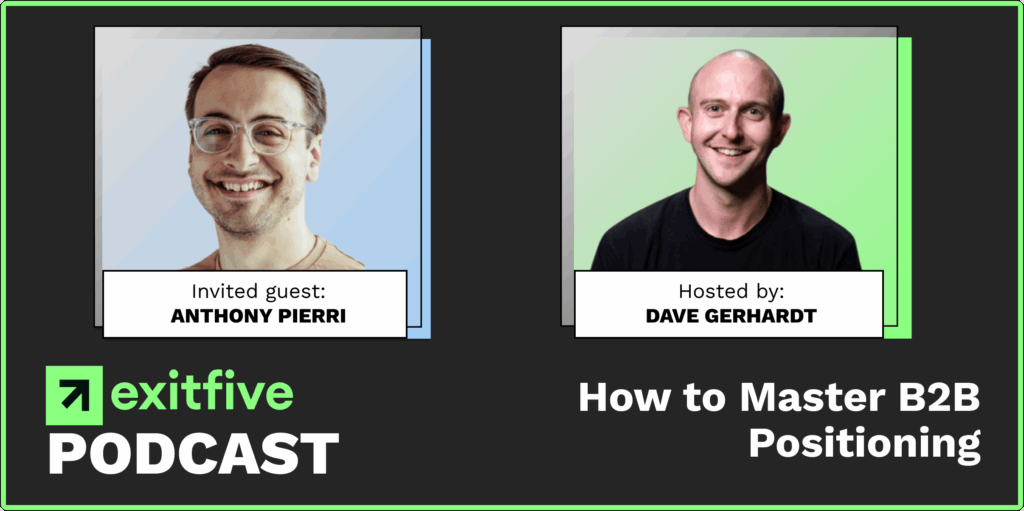
And it’s not because it’s inspirational or high level, it’s actually the opposite. This one is super tactical, very take notes, fix your website after this type of energy. This with Anthony Pierre from Fletch PMM. Since we recorded this, his LinkedIn following has actually doubled. I don’t know how we got this stat, but somebody got it.
He’s at 77,000 followers now, and that didn’t happen by accident. He’s in the weeds every day with early stage B2B SaaS companies working on their website messaging positioning. The big idea in this episode is simple, but most companies get it wrong. It’s that buyers don’t care about features. They care about benefits.
Benefits, benefits. It’s about me, right? How can this make me better? Anthony breaks down how to actually connect problems, capabilities, and outcomes so people understand when to use your product, especially on your homepage and specifically if you’re early stage when everything else feels vague. So one thing to call out before this episode, we recorded this before AI became the main character in every marketing conversation, and honestly, that kind of makes this a little bit better.
It isn’t trend chasing its fundamentals. I think that clear beats clever every day of the week. So check this episode out, especially if your website you feel like needs a little bit of help. This is a great episode for you. Here’s my conversation with Anthony. Alright, Anthony’s here. He was, uh, hanging out on this zencaster link waiting for me.
I didn’t know my camera was on. I’m in the other room talking trash, making a coffee, taking my sweet time. I came back to my desk and I just hear it from a closed tab in my browser. Hello. So anyway, I’m glad you’re here. I’ve been following your stuff. So what’s cool is I made a shift in this podcast a couple months ago to just talk to more people who are like.
Doing the work and I guess I would call it like more subject matter experts. I think for a while I was doing more like, Hey, this person is the CMO at this company. Tell me about being a CMO and managing your team and blah, blah blah. And I think that content is great. It just stopped being as interesting to me and it started and people wanted, uh, what I noticed from the exit five communities.
People want really tactical. If I’m gonna make this podcast, make it a podcast that I can listen to it get better at my job. And so I wanted to bring in more people doing, doing the stuff. And you were on that list. You’ve come up in a bunch of different calls and you mentioned a bunch of the previous podcast episodes, whether that’s Lashay or tass or others.
And so I’ve been looking forward to this conversation for a bit. Can you just tell people so they can hear your voice? Like, who are you, the name of your company, what do you do?
Yeah, definitely. Thanks for having me. Super excited to be on. Uh, I’ve been following your podcast for a long time. The old agency that I worked for, we always would talk about the different episodes when they would launch.
We’d be like, so it’s super cool. It’s surreal for me to be on, but yeah. My name’s Anthony Pieri. I work for Fletch, PMM. It’s a two person product marketing agency that I work with. Uh, my partner Robert Kaminsky. The two of us are pretty much primarily focused on doing one thing, so subject matter expertise is very, very narrow.
Beyond our little niche, you know, we’re not quite as reliable, but within our very specific niche, we primarily help early stage SaaS, B2B startups. Usually the founder or the head of marketing is struggling with having a more horizontal product that can be used by a lot of different industries. A lot of different use cases, a lot of different teams, and we really try to help them come in and figure out the best way to position and messes their product on their homepage.
So the scope of our work usually is focused primarily on just that website front door experience. How do we get across the most interesting things about our product? To our target customers in the clearest way possible. We’ve had a chance to work with a bunch of startups. Um, we do shorter engagements because we’re primarily focused on making our framework and process better and better and better.
So we treat the framework like it’s a product and every chance we work with a company is another chance to iterate on it. So we’ve worked with close to a hundred startups now at this point. And that’s me and Robert directly with all of them. Not like handing it off to associate level people or a big team or anything.
We’ve been in the trenches, which ha obviously has its ups and its downs, but it’s gotten a lot better. You know, companies 95, 96, our process was a lot better and more ironed out than companies. One through 10. So sometimes I feel bad about the early people and I think about sending them refunds for, I don’t know what the heck we must have been doing back then, but it’s gotten a lot better.
Yeah. But you also probably spend more time on them and so they don’t feel bad. You probably delivered something helpful for them, but instead of it, you probably had to spend 10 hours with a client and now you kind of have this nailed where you’re not gonna be able, you don’t have to spend that time.
Right. Hundred percent. Yeah, that’s
a great, great way of putting it.
Don’t feel bad about the money that you earn from that.
Love it. Love.
Have a skill they for that. So you started this business doing. How do you talk about, you have this kind of niche business where you help people do websites, but I see you post about positioning frameworks.
When you talk about the framework, and I want to get into the framework. What is the frame? Is it positioning? What are you calling? What is it that you’re doing?
Yeah, so it’s funny. It’s been a constant e evolution of our own positioning. Even when we started, we spun out of a larger agency that does design and development.
When we were working there, our hypothesis was we could help startups with. Positioning and that was about as narrow as we knew. We knew that April Dunford, who I think was a guest in your podcast, we knew she did positioning and we knew there was something there. And I’m like, we had a hunch she probably couldn’t service every possible client.
So we were like, there’s probably a market there. And so we came in with that hypothesis, positioning and startups. But over time has gotten way, way more narrow and way more specific. And I actually think we’re working with a segment of people that April usually doesn’t work with a lot earlier stage. And so we call ourselves product marketing consultants.
We try to give the qualifier, we consultants who actually help you do the work. ’cause sometimes consultants just come in, tell you some stuff and then leave. But yeah, we primarily say we’re focused on website messaging and positioning with that qualifier being website because your website really isn’t fully representative of your overall positioning.
And just to give one small example, a company like. Notion is selling bottoms up for a lot of their companies to the end user. And then they’re also selling to sometimes top down in enterprises. But they’ve decided to use the homepage mainly to speak to the bottoms up user rather than the enterprise buyer.
So positioning on the homepage is not necessarily, this is everything we do for everyone, it’s just one of your main marketing assets. And so that’s really the niche where we’ve really focused on is trying to help those people figure that out because there’s, the early stages are so stressful. There’s so many unknowns.
You might have 10 different use cases. You’re exploring, you have all these different customer types, but you have to put something on there. And rather than putting something really vague and broad and confusing, we think you can do a decent job even with all the uncertainty.
Have you found that people are willing to pay a price that you’re okay with for that?
’cause like I’ve kind of like in my career, come across as catch, which is like early stage, which is why like if you’re April right April. Can command the big bucks from the IBM competitor or whatever, right. They’re gonna bring her in. And this is not a knock, I, I, I would have a miserable time working with the companies that she works with.
I am much more of an early stage, it’s person. But a lot of the early stage companies, it’s like, I think about this all the time. Like, you talk to the founder or whoever’s doing marketing, it’s like. They want a million dollar or billion dollar positioning, but their budget is like, uh, 500 bucks or something.
And I’ve always found that that to be a miss. Like how have you talked through the pricing point? The price point at this? And I’m also gonna say, just so I don’t forget this, I’ll shut up and let you ran in a second. I also think that it’s very smart what you’re doing in. I think that one of the missing ingredients with positioning is there are many positioning consultants and inside of the company.
I worked at a company once and we hired a positioning guy to come in and he gives us all this and we get this Google doc and I’m like. Okay. But like, this isn’t the, the freaking, like we, to me positioning is the website. Mm-hmm. Like, I’ve always thought of like product marketing and positioning is the website.
And so like if we don’t have website copy, it doesn’t matter what our positioning doc is, the VP of sales is gonna be on my ass because what she’s gonna do is go to the website, pull up the website and be like, this makes no sense. And so I, I think it’s super smart that you’re focusing on the website.
Answer my first question first.
Yeah, for sure. So we have, over time, we’ve realized the power of choosing a very specific niche. And now we’re deep, deep believers, especially if you’re a service business, that there’s just two of us, right? So we don’t need to have thousands and thousands of people to work with at once.
So once we got the niche down, we knew that it was seed to roughly series A as our sweet spot. And at that level you have some venture funding, but you’re not like. Stacks of cash, right? You’re not like sitting on 50 million or something, maybe a 5 million or somewhere around there. And so when we started trying to design the service for that group, we started to reverse engineer what would be things that would make them like it.
One of them is the thing you just mentioned, having a very tangible. Output. When you’re series B, series C plus giant publicly traded, you can pay a ton of money to have a really nice PowerPoint that lays out, here’s our positioning, and then all the teams scurry out and make that a reality. When you’re early stage, you’re not gonna pay someone for strategy.
You’re not gonna pay them for just high level thinking. You’re paying for things that are gonna move the ball forward. And so we said, rather than just selling a really nice PDF, we’re gonna sell. A rewritten homepage because that’s gonna start driving change almost immediately in the same way we said, how can we get the price point lower for these people, but also potentially shrink the size of the engagement?
So it’s still worth it for us. And so one of the main things that we killed was us doing the primary research. So in a past life, my partner and I, we would do jobs to be done on the ground. Customer research. We would synthesize, we’d bring these reports, bring them back to the founders and say, Hey, this is what we found from the customers.
Inevitable. What would happen would be that the founders, if we brought back research that they didn’t like, they would just ignore it or they would say, nah, that doesn’t seem right. I don’t believe it. So we were like, we’re not gonna do that anymore. We’re really just gonna focus in on the parts that we can do, which is we’re gonna have take you as the founder or the head of marketing.
We’re gonna try to extract the work that you’ve done with your customers and your understanding of what you built as a product and help you organize it, arrange it, bubble up, the most important things using our process. And so we often say even in the sales calls that we have with founders. This project is really only gonna be as valuable as the time that you’ve already spent with your customers.
And sometimes people will say to us, we don’t really feel comfortable moving forward because we actually probably go need to go and validate some of the things we’re thinking. But other people will come in and they’ll say, I’ve listened to all my gong recordings. I have a pretty good sense. And then those projects are obviously way, way better.
But so all those things we’ve been able to design the service. It’s way lower price point than someone like April. Probably like a factor, like a one 10th or one 100th of what she would charge, but it’s because it’s way shorter than what you’ll do. I’m pretty sure she does customer interviews. I think she’s like actually meeting with people.
So we don’t really do that. We run some workshops with the founders and the heads of marketing. We have a copywriter that we work with on our team who then. Help arrange it into a page. Uh, some designers who sometimes help with that piece, but essentially we’ve, that’s been able to shrink the package where it’s, it really is a win-win for everyone.
They actually get to move a lot faster. It’s usually like a two week turnaround rather than a multi-month project so they can get something up and, and running and get feedback on. But then it, it still is a very viable product for us as well.
So you’re not doing the customer research, but. Are they providing their customer research to you and then you’re able to like read through it and digest it and write stuff back.
We actually have them synthesize their own research, and so that was even one of the ways we helped shrink it a little bit because the other thing is since we’re solving this one very specific problem. Across a ton of different industries, even within SaaS. People talk about SaaS as a niche, like that’s so unbelievably broad.
We’re working with deep ai, ML technical companies. We’re working with construction companies. We’re working with all sorts. ’cause SaaS exists. On a very, very large spectrum. So rather than us pretending like we’re gonna be able to go in, read through all this stuff, become subject matter experts, we just say, we’re gonna require like coax this information out of you in the best way that you can give it to us, and then work from that as our starting point.
Yeah, I love that. One of my favorite parts of the marketing stuff is the positioning and messaging and copywriting, and I’ve often thought like I’d love to start a business where I help companies do that. The process that you just mentioned is the exact reason that I didn’t want to do that because, you know, companies wanna like hire you and then they expect in like, you know, two weeks for you to become an expert on their customer base.
When it’s like, come on, you, you have this information in your head. Like it’s either in your, and you’ve worked with any founders in the past. The founder usually. Has a deep understanding of the industry anyway, because they either had this problem before or did a company before, or like some reason led them to start the company.
Every company’s using some type of like call recording or note taking, like you have all that stuff, and I think I’m a better copywriter than I am somebody who knows about. An industry. And so if you can surface the common pain points and objectives and challenges and reasons, people buy your product, if you go and listen to Lasher’s podcast, she has this template for bottom of the funnel content.
It’s basically all these great questions that she asks people to give her so she can create that content. If you’re a good writer, you have that, you can go and create that. So I think it’s wise that you put it on the company end. If they can’t give you that, they got bigger problems than like trying to figure out what messaging should be on the homepage.
Right?
A hundred percent. It’s a problem at that point. Way higher up the chain. That’s a product strategy problem. Yeah. A, you know, target customer problem, all those types of things that we’re not gonna weigh, weigh in on anyways.
I also think what’s smart is, um, you know, too often the positioning doc is a Google doc and it just becomes that, and then it needs to be translated in other things, but like.
To me, nailing your positioning means nailing the website, everyone from prospective customers, to future employees, to investors, to acquirers, to whoever. What are they gonna do when they wanna learn about your company? They’re going to Google you or go to your website and they’re gonna make the best conclusion about what you do based on your website.
You have to be like in the funnel at a different stage to like see the deck or to see the pitch, or to see the presentation. And so I’ve been in multiple conversations with founders and they’re like, ah, duh, don’t look at our web. Don’t worry about what’s on the website right now. I’m like, no, no. What do you mean the That’s all there is.
The website is the thing, right? A hundred percent. Yeah, totally agree. You started off not in tech, right? And you’ve now done a hundred of these B2B SaaS startup websites. Did being an outsider, now that you have some wisdom on this, did it help you in any way? Did it hurt you or any way in any way? What perspective were you able to bring as, as an outsider into this industry and, and how has it helped you in this job?
Yeah, that’s a great question. So I think it’s drastically helped me. I worked in a lot of industries that were not so much on the up and up as B2B SaaS is, and so a lot of the toil and the struggle to turn things around. So just to give you some context, I used to work in a lot of different churches actually.
So I worked for like a very large megachurch for a while in Chicago. The church was actually declining in attendance and there’s giant societal. Trends and shifts of all why this is things that we can’t really control. So me and some of the other people working there were like really trying to turn this around and we brought as much energy and innovation and and thoughtfulness as we possibly could.
We slave at this trying to make it better and better, and we still weren’t really able to ever move the needle. On the side of that, in my last professional life, I’ve always been involved with, like I’ve had bands and stuff with me and my friends. So I’m currently in like a pop punk band with some of my good friends.
But I’ve been doing that for a long time. And those are more B2C, or not even B, really just like consumer type stuff. And growing something in a consumer world is just very, very difficult. So like those two pieces of my life of always trying to grow these things in very difficult environments and kind of consistently failing.
When I took the same level of energy and focus and put it into tech, and specifically B2B SaaS, which is an industry that is growing and becoming more prominent in the world. It just took off and, and like I’ll even talk to other people and I’m like, it feels like it’s so easy. And sometimes they’re struggling and stuff ’cause they’ve only lived in that world forever.
And it’s like, I think it was like Mark Andreessen or someone who was saying, would you rather have a great team, a great product or a great market? And now I’m like, it’s the market. Being in this world, there’s just so much more opportunity. And so I took a lot of my background, which is around content creation and, and teaching and things like that.
Pointed it towards. A platform like LinkedIn and me and my partner have been able to really, really grow our followings pretty quickly. All things being equal in ways that when I tried to do this on the consumer side for my own personal music pursuits and things like that, was never really able to get that same level of growth.
I think the outside perspective though has helped a ton coming in. And also it just kept me from having any level of ego coming in. So like not being like, well, I have this giant career as a product manager and so that’s who I am and I’m not gonna change. I was more open to what’s the best spot for me to find.
Where I can take my talents and put them when it’s gonna really be helpful and basically stumbled into product marketing and positioning and messaging and all this type of stuff. And even my partner who has actually worked long time in tech, really big career and startups, and he worked for really big companies like Oracle and stuff.
He was even at the beginning like, do I want to just be known as a product marketer? I have so much experience in tech and so for him it was a really hard decision to say like, this is what we’re gonna focus on. But for me, I’m like, I’ll take whatever I can get. Like I’ve been floundering for the last 15 years, like without really finding a spot.
So those are probably like the biggest things that I’ve seen coming in from the outside.
You mentioned something interesting, which is, um, you’ve been able to build an audience, grow following on LinkedIn. I just pulled you up. You have 34,000 followers, which is. Plenty to run a, a successful business on LinkedIn, named you a top product marketing voice, which is so fantastic to help.
To help the brand. Right. It’s great. We’ll take any award that we can get for sure. But you mentioned like basically if you were writing content about music, for example, right on LinkedIn. That might be fun for you, and it might scratch a passion itch, but it’s not gonna help you build a following and build a business because it’s too wide.
There’s just so much there. But now all of a sudden you shrink this down and you’re basically like, Hey, I’m going to use LinkedIn. And on LinkedIn I’m gonna talk about positioning and messaging for B2B SaaS startups. You start writing really tactical, practical content about that. Now you have posts that have a thousand, like 360 comments.
Right? And you can, your inbound machine can be driven from your LinkedIn. I think that’s just a great example of what it takes to grow an audience online. You can’t write about anything that you want, really. You, you can. It’s great. Have fun, do it. I do that all the time, but I don’t expect any results from that.
Like if I was trying to grow something that’s gonna help grow the business, it’s gotta be focused on a niche like you have, right?
A hundred percent and, and honestly, like we now tell everyone who’s thinking about going solo, you’re a single solopreneur, find something very, very small that feels uncomfortably small, because that’s usually where you’re gonna make the most traction.
Even just the way that algorithms work, like algorithms are trying to find the most targeted content. And show it to the people who care about that the most because it’s gonna make the platform better. Like that’s our litmus test mostly for our content. What’s gonna help LinkedIn the most? What’s gonna make people come back to LinkedIn the most?
It’s gonna be content that’s extremely tactical that people could use immediately. That feels. Perfectly tailored to their job. And so the more we just lean in to what LinkedIn would want, the more the algorithm is just doing all of our distribution for us. So, you know, we’ve never ran a paid ad. We’ll do podcasts and stuff like this, which is always great, but the primary driver of our, all of our business is LinkedIn.
People finding our content and, and we always know. A sales call is gonna close. If the person gets on the call and says, I’ve been reading your content for six months, it’s so valuable. I know we’re probably gonna close. Versus someone comes on and says, oh, someone mentioned your name. I’m not really sure what you do.
I’m like, there’s no chance I’m gonna do the whole demand generation process in the next 25 minutes and convince you of this.
I totally agree. I I’m not doing any now, but for like a year or so after I left my job, I was doing consulting and I only did inbound and I learned this. Not the hard way, but there’s just like one or two engagements that weren’t the right fit.
But the best relationships and the best customers were the ones that came a hundred percent inbound. They wanted to work with me specifically. They were like, Hey, I’ve been following this thing that you did and you did this thing, and I wanna learn how to do that. And I’m like, okay, this I, I can really quickly just read who’s gonna be the right fit to work with.
And it’s like, in your example, it’s like, yeah, all these people are. Already indoctrinated with the way that you think and they know what they’re gonna get. Versus like, if you’re like, Hey, do you need a new website? Uh, well, I don’t like, and you gotta pitch. It’s like, no, I don’t want to, I don’t want that business.
I don’t, I don’t, I don’t wanna be trying to pitch this. Right. Like, tell me about the framework. Let’s talk about the framework. What is the framework? Where did it come from? Is this the framework that I see that you post a lot where you kinda have this like colored text where it’s like benefit persona, capability, problem feature, category ICP?
Is it like just mad libs you? You fill in the blank? What’s the framework?
Yeah, so it started. Originally when we were like, we wanna help with positioning, and we thought the website was a place where this would show up. So we said, let’s try to audit some websites. Let’s figure out how are people positioning today.
And what we quickly realized is when you look up the different Mad Libs that exist about talking about positioning, we’re a blank type of company that helps blank type of customer. We quickly realized that every one of the words that people throw around don’t really have an agreed upon definition.
Nobody really knows what their value proposition is. Nobody even really knows what the word value means. And then we’d see stuff like, people don’t care about features, they care about benefits, you should lead with benefits. All sorts of stuff. Even like a problem. What? What constitutes a good problem versus a bad problem?
So we would do these really lightweight audits where we would take someone’s website and we were in Miro at that point, and we’re in Miro, we’re using sticky notes and we basically mark out, Hey, this is the problem I think you’re solving. Here’s the features that power it, the benefits. And we would post this and then we’d get all sorts of comments and we’re trying to follow what everyone is saying, follow the market.
What we realized was that before we could do anything, we needed to spend a bunch of time just defining what do these words mean? So we have like a glossary of definitions of each of these specific things that we’re constantly updating and we’re, and we’re getting better and better, even about specific words.
And so these types of words become the basis for building. Messaging and building value propositions at a high level.
Those things that you listed out, like those would be, I guess if you had like a classic, like if you Googled like what is a positioning statement, that’s what those are, right? The classic positioning statement is like.
For target customer with benefit. You know, I, I don’t even forget, I don’t, I haven’t used one. I just kind of make it up. But Is that what that’s based on? Like the kinda like classic positioning statement? Yeah, a lot. It’s loosely
based on that, but for us it’s really about the messaging elements. And we talked about, we had a post once where we had a periodic table of messaging elements and things like that.
We’re getting all clever and stuff, but ultimately it’s, it’s like, what does it take? To write a value proposition end to end. What are the pieces that you actually need to know? So we have several components and I can, I can list them off quick for us. When you think about a customer segment, it really has like five or six different things within it.
One, what type of company are we talking about? So company type. That’s one of our blocks. Two, what’s our persona that we’re targeting? And we use that word, we’ve called it persona, we’ve called it champion. It’s essentially like who’s the person that’s gonna be most interested in pushing this deal through?
Knowing that the vast majority of B2B SaaS deal cycles are six to 12 months, who’s the person that we wanna get involved early on? Who’s gonna help us meet with procurement and legal and their boss and their boss’s boss, and the technical buyers and everything? You have to find someone that you’re gonna target.
Specifically, and that person’s usually on like a team. So the level of specificity is sort of dictated by the product and the willingness to go more specific of the founders and the heads of marketing. So company type, persona, or champion. And then the piece where it gets a little bit more interesting is we’ve had this box for a long time.
We’ve named it 25 different things. Essentially we’ve been calling it more often the situation. It really falls into one of two buckets we frame and as I’m trying to do blank, and that could be, I’m trying to do a specific set of activities. I’m trying to schedule a meeting with someone online. It also could be a desired outcome.
I’m trying to increase conversions on my website. So this box, it’s like sometimes you would see it as like the job to be done, box, and, but even jobs as its whole own history and stuff that we’ve stayed away from calling it that. So you have a, a type of company, you have a person in the type of company who’s in a specific situation trying to do something, and then there’s one level deeper, which we call the current way, which is what tools, processes, how are they executing on that essentially situation box, what are they actually doing?
And then from there. What are the problems? What are the problems with doing it that specific way? So when you walk that out, that actually is what constitutes a segment. And you can remove some of the elements and it’ll be a little bit less clear. But an end-to-end segment of customers is both not just firmographic specific user type.
But it’s also what are they actually trying to do? That’s like what creates the opening for the use case of when a product would come into the picture, and then what specific problems are they running into? So like, to give you an example, let’s say you’re a marketing head of marketing at a B2B SaaS company, and what are you trying to do?
You’re trying to schedule meetings with other people that you’re working with. Problem. You send emails to people, they don’t know your calendar, so you have to send back and forth, and it gets really annoying to go back and forth. So like that market segment is a prime market segment for a product like Calendly, which we use Calendly, our business runs on Calendly for everyone to book it.
So now when you’ve got the market side, now you have to say, okay, well what do I wanna talk about on the product side? How do I wanna actually connect product, market fit? All that pieces is even in the name, right? Product marketing. How do we wanna talk about the market? How do we wanna talk about the product?
What do we wanna elevate to the top that’s gonna actually make this interesting? So rather than talking about features and benefits, which is essentially how most people talk about products, tell me about the features. Tell me about the benefits. There’s actually a third capability, so, so that’s actually the word.
The third thing is called the capability. Which is essentially answering the question, what do I do with the product? The feature is like the technical aspect of something in there, like it’s usually like one or two words, like notifications, a dashboard, analytics. Those are like features. The benefits are the outcome of actually doing the capability.
So for Calendly as an instance, the shareable. Booking link is the feature and the capability is, what do I do with this? You let other people book time directly on your calendar. The benefit then is why would that matter? What would be the outcome that you’re looking for? And it usually will be the inverse of the problem.
So if the market segment, the problem is it takes so long to get meetings scheduled. The benefit of using a tool like Calendly is you can schedule meetings. Way, way faster, you know? So essentially on the product side, you have feature capability, which is missing for most people’s definitions that usually are just features and benefits.
What do I actually do with the product? Then you have the benefit, which is the outcome, and then really the last element on the product side that often. A struggling point for early stage startups is what product category are you in in the first place? And sometimes this could be a mix of multiple product categories.
If you’re doing something new, maybe it’s a brand new product category, or you exist in a, an existing category, but you’re modifying it in some way. Like TikTok, when TikTok comes out, they were in the product category of like video platform. Yeah. But they carved out a sub niche short form video. They dominated this whole space that was a subcategory of the big one.
So product category, obviously it’s a giant topic in and of itself.
Is that what you would call the differentiator? ’cause like April harps really strongly on differentiation and I’ve gone in different waves of positioning, school of thought. But in working with a couple companies over the last few years, I do find that it does come back to differentiation and that like, yeah, there’s a thousand other tools or perception, but like what is your.
You have your value prop, but that has to be based on some differentiated position. And she gave an example on our podcast a couple episodes ago of, uh, I was like, you know, what do you do when the company really has none or needs to innovate on that? And she’s like, well, I have this one company that I worked with where.
From a technology standpoint, they weren’t doing anything unique. They weren’t doing anything new, but they were the only company at the time that was offering basically like full scale custom services. Like we will do it for you. And so like they switched the messaging to be like, Hey, you want this?
There’s lots of companies that do this, but we’re the only ones that will do it for you. And that’s a perfect example of like how differentiation works. When I was at Privy there, we changed the messaging to be something from like, it used to be like a website popup tool to capture email addresses on your website to, we wanted to reposition the company to be more of a marketing platform, but.
We wanted to focus on small businesses, so solo entrepreneurs and small Shopify stores. Like, Hey, there’s lots of other tools you could use. If you have this massive marketing machine, you should be using something like Klaviyo as an example, right? But if you’re a solo entrepreneur, you don’t have a marketing team, you don’t have a full unit behind this, like you should use our tool.
And that became a powerful differentiator. So how does that fit into where, because I feel like you can do all the frameworks that you want, but when you’re working with a company. They need to have that clear differentiator. If we, if we have the clear differentiator, then the positioning exercise becomes easy, right?
Yeah. And so we see it two ways. We see that in the early stages of a startup. The question is not why you over the competitors. The question is actually, when would I use you? So most early startups aren’t really directly competing with other companies because they’re often new additions like, take Calendly.
There wasn’t really a direct competitor to Calendly when they came out on the market. And the question was more, when would I use Calendly than why would I pick Calendly over other scheduling automation tools? ’cause that wasn’t really a thing yet. So for us, the way we think about differentiation is in the very early stage, we would call this contextual differentiation, which if, if later stage is more competitive differentiation, when would I use, for example, the ARC browser.
A lot of people talk about the ARC browser. It’s a brand new. From a company called the Browser Company, it’s like a Chrome competitor. Safari competitor. Extremely competitive, saturated, mature market. Internet browsers, we know what the options are. We know what’s available. So the question, when someone comes out with a new browser, the question you immediately have to answer is, why would I pick ARC browser over Chrome or Safari?
And so the impetus is on pure competitive differentiation. Well, they do things for this, we do it in this way. All that stuff that you mentioned in the early stages, it’s a bigger question of saying contextual differentiation. Here’s how you normally execute a workflow. You normally would send an email, you’d look at your calendar, you’d write down the times that you’re available.
You send it over email, you wait for them to respond. They come back, oh, none of those different didn’t work. Or Maybe I’m in a different time zone than you. Here’s one some back. And you go to this back and forth, and that’s like an annoying workflow. So contextual differentiation would say, take that context, and now here’s a brand new way of doing it.
You share one link. It has all the pre-selected times that they can choose from. They book it, and then Calendly will invite both people. To the meeting. So for us, that’s where the differentiation changes from early stage to later stage. So yeah, that, that’s sort of how we view it. What’s the most
common mistake or the most common?
You know, you got 300 companies that reach out to you. You start to see some patterns. What’s the most common mistake with positioning and the website that you see?
So B2B SaaS specifically, they get wrapped around the axle in one very specific way. Most of the time, it’s a marketer or early founder.
Usually our early founder who doesn’t actually have in-depth marketing experience because the founding team of most companies is a builder and a seller. I’m gonna be the technical guy. You’re gonna go out, sell the investors, sell early customers. Most companies don’t really have that marketing represented.
That’s why the question is, when should we hire our first marketing hire and VCs, they don’t really have marketing background. I think it’s like Emily Kramer, it’s like said, it’s like 1% of VCs come from marketing world. So the whole ecosystem is kind of missing this marketing piece. So the only marketing that most people know is like one piece of advice that’s taken drastically out of context and misapplied over and over and over again.
It’s the. Buyers don’t care about features. They just care about benefits. They don’t care what your product does, they just wanna know the outcome that you can deliver. And there’s a, a famous picture of Mario and he eats the little thing and then they’re like, you don’t sell this. You sell. And Mario’s really big.
Yeah, that’s my favorite. So you, you take that image, you take that advice. You take the idea that buyers care about the outcome. The other one is the, you’re not buying a quarter inch drill, you’re buying a quarter inch hole. All, all the most common ones. It’s like if I started golfing and my only knowledge of golf was from the movie Happy Gilmore, where he says It’s all in the hips.
I’m like, that’s all I have and I’m going off of that and I’m gonna go start learning golfing and I’m swinging my hips all around and I’m looking like an absolute fool. But I don’t even really realize it. ’cause that’s what everyone is doing. So when you look at websites, 99% of them in early stage. Are just talking about outcomes.
And remember the question that you want to ask in the early days that most people are wondering is, when would I use this? And talking about outcomes does not answer that question. So I just did a big post about this. Um, I won’t say who the companies are, but you could easily figure it out. These are just a couple of the examples of some websites of current early stage companies.
Product growth unlocked activate more users, increase feature adoption, and drive expansion revenue. That’s the H one, H two of the hero of their product.
Hold on, I’m gonna give you more right now because this is your work. I’m gonna write about it. Uh, I’m gonna talk about great teamwork, starts with the digital hq.
It’s so good. You know that one. I do it. You know that one? I, I definitely Another one. Connect everything. Achieve anything. Yes. Yes. So, so one more? Yeah. One more. One, one platform to connect. This is, you have not to take us off this track, but you have this great post, which is like the message clarity degrades over time, which is like so true.
I’ve been at a company long enough to see that, but like you have. Zoom years ago just said, use Zoom for video conference rooms in your phone. Mm-hmm. That’s fantastic. What’s wrong with that? Mm-hmm. But then we try to overmarket it and all of a sudden we have one platform to connect. Or you go back to the original Slack messaging, which is today.
It’s the great teamwork starts with the digital hq. The old messaging was Slack replaces email inside of your company. Amazing. Oh, interesting. Okay. Tell me why I need that. Okay. I see an enemy, email’s the enemy, but then they make a couple of acquisitions. You know, a lot of bunch of things happen and then you gotta, you gotta change the network.
This is why I gotta be a startup guy. I can’t, I can’t do this nonsense. I
can’t do it. I know, and I actually, it’s so funny that post got so much heat because so many people, a baffling amount of people came out swinging, defending, connect everything, achieve anything. And it, it really, it fell into like four different buckets.
So much that I did a follow-up post and then another follow-up post. ‘
cause I was so upset and I bet, I bet there was also people in the comments, well, like, well, Slack’s a pretty, you know, slack, Airtable, and Zoom are pretty successful companies like, okay. Most of 99% of us on this call are not going to be one of those companies.
Right. Like one out of a hundred thousand startups has a successful exit. You’re not gonna probably be that company. And so like, don’t pander to that.
Exactly. And then, so my first rebuttal was. When they basically said, this is good, right? It really fell into three buckets. People said either the unclear messaging is inevitable.
’cause as your company gets more complicated, it just has to get vague. ’cause you’re serving so many different customer types, different buyers and all that stuff. So one was, it’s inevitable. Other ones said it’s strategic, where they said, no, no, no. Enterprise buyers like that. They like to have you talk about the nonsense, like I use the example today.
This is a real company. This is, and I, I don’t feel bad calling them out ’cause they’re worth like 200 billion or something. ServiceNow, their hero said, put yes to work, save, or grow, satisfy shareholders or satisfy customers. When facing tough choices. Choose the one platform that lets you say yes to both.
And then the CTA, the button says make yes work. That’s the button they want you to click. So they were like, people were arguing, no, no, no. These big hotshot enterprise buyers, like that’s what they want. Which I’m like, I feel like it’s insulting to their intelligence that they’re just looking around for like the shiniest, oh, I wanna buy that for my 10,000 person company.
’cause it sounds, I just don’t think that that’s true. And then a lot of people were like, it doesn’t matter. They’re so big, who cares? You know where I’m like, I also don’t think that’s true. I think it’s pretty important people spend millions of dollars on branding refreshes and homepage, like when you’re a big, so I think it does matter, but I think it’s more what you’re saying, that it’s the internal stakeholders are all kind of fighting for what they want it to be, and there’s like this political battle, and I think that’s how you end up with some of this stuff.
But all of that stuff, right? To your original question, this overemphasis on outcomes, vague benefits, without ever saying, when would I use this? How would I use this? Why would I use this? That is the most pervasive problem facing all of tech startup websites, in my opinion.
I, I need to ask you something else, but I just happen to look this up and this is fantastic.
So I went to salesforce.com and I went to hubspot.com. The headline, Salesforce’s headline is Grow Faster with Salesforce. HubSpot’s headline, grow Better with HubSpot.
So that enterprise
buyer, how good is that?
How good is that? They’ve got two. This is in their minds. This is what people’s minds. I’m A SVP at some Fortune 500, and I’ve got both pages up and I’m like this. Which one do I pick? Do I wanna grow faster or do I wanna grow better? This has really made it easy for me.
I want grow faster. So they’re gonna choose,
I’m gonna, I’m gonna make this, I’m gonna make a LinkedIn post. People are not gonna like that ’cause I know people at both companies, bris. That’s great. That’s great. Yeah. Which one do you want? Do you want to go faster or do you want better? Do you want faster or better?
In the
silly part, what I try to combat. The objections was there are large companies that are still very clear, like Stripe. Stripe was the most valuable startup, I think in the world, maybe still is based on their valuation and all that stuff there. H two underneath the main headline, millions of companies of all sizes use Stripe online and in person too.
And then it says Accept payments. Mm-hmm. Send payouts and automate financial processes. So that right there is like three example use cases of when someone might use Stripe. Giant company. Really complicated. Does a million things for a million different people. Clear messaging. So I’m like, you don’t, it doesn’t have to be bad.
You could make the decision to not make it bad, but for all those other factors, it ends up staying bad for most of these big companies.
Alright, we, we will have to have you back on in a couple months and do a follow-up session and talk more, but. One thing I want to get your perspective on is talk to me about what’s your point of view about the homepage headline, and you have this kind of value prop positioning statement that I’ve seen you post and we talked through it earlier.
Since you do websites and you have this, that’s the output. Where does that lead? What’s your, does, does it have to be in the headline? Is the homepage headline matter? Is that where you write the full statement? Can people or, or do you kind of give ’em a taste and like you get the picture from the website by scrolling?
What’s your point of view on the, on the role of the headline?
So the way we think about it is we, we call it your minimum viable positioning shows up in the H one and the H two on your website. Just the hero image. Sometimes even if you can get the like trusted buy section with the logos, if you can squeeze those all into a hero, you can communicate a lot of information.
So when we think about minimum viable positioning, it’s essentially you have to say. One of those messaging elements from the market side and one of the messaging elements from the product side. You can’t have everything from one or the other or in some of these cases, none of them, right? Like put yes to work or whatever.
That doesn’t have any elements of anything, so. What you really need is something about the product and something about the market in order to create a message that will potentially resonate with anyone. So you see a lot of examples of this. Good examples of this are when it actually says like, here’s the use case of maybe when you would use it.
That’s speaking to the market side. And then maybe you say, we’re the product category for this specific type of person, like we’re the CRM for small businesses. Even that saying we’re the CRM for small businesses is enough for you to go. Interesting. I’m gonna read on, I have a loose idea of what you do because CRM would be on the product side.
Small businesses would be on the target customer side, but it doesn’t have to be like a vertical slice of like, we’re only talking about this industry or this team. It could also be use case based, right? It could say something along like, it’s so annoying to book meetings online. We let you book them with one click or something like that.
That’s the problem on the market side with the capability on the, the product side. There, there was another one too, like, uh, loom, who just was acquired by Atlassian. Their messaging was really, really good for a long time, and it was around, they made the enemy was meetings and so for a while their H one was.
Meetings off Loom On or something like that, or Loom on meetings off. And so even in there they were saying people who are in meetings and don’t like the meetings. And then underneath it it was like send quick videos, which we would call a capability and reduce the amount of time you spend in meetings by 29% it with some outcome.
But across that, like it’s, it’s like we would call it holistic messaging. You’re not just talking one thing on one side, you’re painting a picture bridging between product and market and. Again, you do not, because you’re early stage, you probably can’t fill out one of those Mad Libs end to end because you don’t actually know yet, but you can say something about the market side and something about the product side, and that’s enough to get you started.
I love the Loom example. That’s a great. Because like, I think you can have the value prop be the headline, but to me that’s like what you should do if you don’t have like good copy or something witty. Like I think a website should still have that good punchy hook. It doesn’t need to always be like, the world’s all in one CRM platform, right?
Where like, I like the, you know, say goodbye to meetings or, or, or whatever. Um, at Drift for a while we had this, we kinda did this whole brand campaign around, um. We said, welcome to now. And that was because we kinda came up with this whole narrative that like traditional B2B sales and marketing software was about later.
Like, fill out this form and someone get back to you later. Right? And so we came up with this campaign at Drift, which is like, welcome to now Drift connects you with potential customers right now. And so if the homepage just said, welcome to now, people would be like, Hmm, I have no idea what you do. But if you say, welcome to now is the headline, and then as you go down the page, you’re like, welcome to.
Now Drift is the leading conversational marketing plat. You know, drift is the only conversational marketing platform that helps you do X, Y, and Z. That gives context to that, right? And as you scroll down that loom page, you start to understand, oh yeah, I understand what this tool does, and so this does make sense.
I can get rid of meetings right there. So I think that’s an area where a lot of companies. Get stuck is the, I have a love and hate with the homepage headline. I think it’s very important, but I also think at the same time it’s something that the VP of sales and the VP of Customer Success and VP of Product and VP of Marketing, like argue about for no real reason when, especially in B2B.
It’s the whole of the, like the headline to me is a hook. It’s like to get you, the goal of the headline is to get you to read the next part and the next part and the next part, and then you understand it and then you’re going to raise your hand and be interested in it. It’s not like I’m not, I have no idea, you know?
And I don’t think we need to obsess over it as much as we do.
And we say in general clear for early stage startups, clear is usually better than clever. That if you have to prioritize one over the other, you should try to be clear first and then the. Cleverness will come
later. I love that people hit the rewind on your podcast thing and go rewind 15 seconds.
Clear is better than clever and. If you’re gonna go clever, it has to be like the clever that everyone in the company like instantly gets, like, go and test it with 10 or 20 people. It’s like you can’t tell the joke and people don’t, yeah. It can’t be a joke that like, you know, you, you can’t quote some obscure line from a movie that not everyone’s seen.
If you’re gonna use the joke, you gotta make sure, like the whole industry knows the joke, knows the punchline. And like
Uber for example, Uber’s early website headline, I think was everyone’s private driver. Which is like very clever, but also very clear of what Uber is. Like someone’s gonna pick me up and drive me from one place to another, and that’s when they were doing the black cars where it was much more high end and so they were like pitching that vision.
But yeah, you, you can be clever as long as you’re clear if you’re early stage because you don’t have any room and you have no credibility. For people to just wanna learn more about you because of all this recognition that you, you don’t have yet. So you have to be clear, and usually in our opinion, if you can get in the hero, the H one or the H two, the main use cases, or the main capabilities that your product can do, when you would actually use it, how you would use it.
If you can get that in there, it’s gonna make you exponentially more likely to have people keep scrolling to see the rest. All right,
Anthony, thank you for coming on. I got a lot of notes. I’m excited to put this episode out. We should set it up to email each other in a month or two and book another time to come on.
I would love to, you know, maybe we could do something in four, four exit five actually, where we’re like showing people examples. That would be, that would be really cool. Anyway, this is great. Go to LinkedIn. Go find him. Anthony Pieri. He’s got a guitar emoji next to his name ’cause he, he can shred, he’s a top product marketing voice on LinkedIn.
And I just think whether you’re gonna buy from him or not, uh, if you wanna get smarter about positioning and messaging, if you’re a B2B startup, great person to follow and you can do the. Best thing for me, which is send Anthony a message. Tell him that you learned something from him on this episode and then he’ll screenshot and send it to me.
Those are the things that make me happy. Other than that, Anthony, thank you man. Great to have you on. I wish you continued success in the business. Keep sharing your practical content. Uh, it’s very helpful. I’m learning a bunch from it as you go, and I appreciate you taking the time to come on.
Definitely.
Thanks so much for having me. It’s been a blast. Alright. Thank you.
Hey, thanks for listening to this podcast. If you like this episode, you know what? I’m not even gonna ask you to subscribe and leave a review because I don’t really care about that. I have something better for you. So we’ve built the number one private community for B2B marketers at Exit five, and you can go and check that out.
Instead of leaving a rating or review, go check it out. Right now on our. Exit five.com. Our mission at Exit five is to help you grow your career in B2B marketing, and there’s no better place to do that than with us at Exit five. There’s nearly 5,000 members now in our community. People are in there posting every day, asking questions about things like marketing, planning, ideas, inspiration, asking questions, and getting feedback from your peers, building your own network of marketers who are doing the same thing you are.
So you can have a peer group. Or maybe just venting about your boss when you need to get in there and get something off your chest. It’s a hundred percent free to join for seven days, so you can go and check it out, risk free. And then there’s a small annual fee to pay If you want to become a member for the year, go check it out.
Learn more exit five.com and I will see you over there in the community.