
Stop making ads that look like ads (Dave's Newsletter)
.svg)

Rippling's VP of Marketing on Why Scrappy Creative Can Win in B2B
I don't get it.
Why do so many ads look like ads?
Instead of getting attention, they blend in and get ignored.
These "ads" look more like email signatures or banners you might throw up at your tradeshow booth.
I get why it happens. We're in B2B. We’re more worried about playing it safe, getting approval, and being "on brand" than we are about the one thing that actually matters: can I get someone to stop and click this?
"I do not regard advertising as entertainment or an art form, but as a medium of information. When I write an advertisement, I don't want you to tell me that you find it 'creative.' I want you to find it so interesting that you buy the product." - David Ogilvy (Ogilvy On Advertising, 1983)
So B2B advertising should first be a game of attention, and right now Rippling is winning.
They have built one of the best brands in B2B and they're a perfect example of what we’re saying here.
They sell to HR. Doing $500M+ in revenue. Big marketing budget. And yet some of their best performing content was made by two people on the team who walked outside in NYC with an iPhone that afternoon.
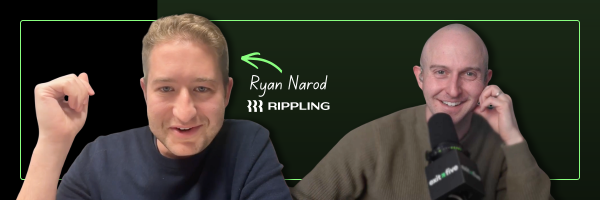
Ryan Narod is VP of Marketing at Rippling. His team tests scrappy iPhone content against polished, high-production creative and the scrappy stuff performs nearly as well. Sometimes better.
I had Ryan on the podcast recently and he walked me through how they think about creative at Rippling. Here are three plays worth stealing.
1. Make It Look Like Anything But an Ad
Rippling had a webinar coming up with a customer from chess.com. So they put the guy in a full chess piece costume, walked him around the streets of New York, and filmed a 30-second promo. For another webinar with Kraft Heinz, two people went outside, bought some hot dogs, and shot a promo on their phones.
These are webinar promos. The most boring format in B2B. But you'd never know it.


Your content is competing with friends, memes, news, and job announcements in someone's feed. A branded graphic with a headshot, a title, and a date isn't going to win that fight.
The two people making these videos at Rippling aren't a production crew. One is their social media manager. Her role is to be the gatekeeper of quality for everything that gets posted. Teams across the company come to her with their webinar or product launch, and she figures out how to make it worth watching. That's a role worth thinking about, even if it's not a dedicated hire. Someone with taste who can push back and say "this isn't good enough yet" before anything goes live.
2. The iPhone Version Might Work Just as Well
Rippling creates customer stories at every production level. They did a full cinematic piece with Barry's fitness. Real production crew, shot in LA. But they also send one person to a customer's office with an iPhone to shoot a case study on the spot. No script, no lighting rig, just a real conversation about how they use the product.


Ryan's take: the high-production content doesn't outperform the lo-fi stuff by an order of magnitude. In many cases it performs about the same. And the scrappy version takes a fraction of the time and costs almost nothing.
Most teams I talk to are waiting for the budget, the agency, the right customer. Meanwhile you could send someone to a happy customer's office this week with a phone and come back with a real piece of content by Friday. A real human, in a real setting, saying something authentic. That's what people actually want to watch.
3. Post It Organic First. Then Put Money Behind the Winners.
Here's the play that ties it all together. Nothing at Rippling is "purely organic." Everything they create is designed to eventually fuel their paid engine.
But it starts organic. They post the scrappy webinar promos, the customer videos, the weird street content. They see what gets traction. And then the winners get budget behind them.
Your organic feed is a free focus group. You can test five pieces of creative this week, see which ones your audience actually engages with, and only put paid dollars behind the ones that already proved they work.
Rippling takes it further. They run lo-fi creative against polished creative in parallel to the same audience and track three things: CPM (which tells you which creative the algorithm prefers to serve), view completion rates, and engagement. They use Paramark for mixed media modeling to measure the incrementality of each channel on pipeline. Then they double down on whatever wins.
And here's what stuck with me. Ryan said people who see Rippling's top-of-funnel brand content convert through their bottom-of-funnel ads at twice the rate. He has Gong recordings of prospects getting on sales calls saying "I promise this isn't for the AirPods. I've been seeing Rippling everywhere."
That's not brand or performance. It's both working together. And it starts with posting something organic to see if anyone cares.
— Dave
P.S. What's the scrappiest piece of content you've ever made that actually worked? Hit reply, I want to hear about it.


The Exit Five newsletter

Sponsor the exitfive newsletter