
.svg)

The Biggest Shift In B2B Marketing Right Now (Hint: It Has Nothing To Do With Vibe Coding A Bunch of Random Apps)
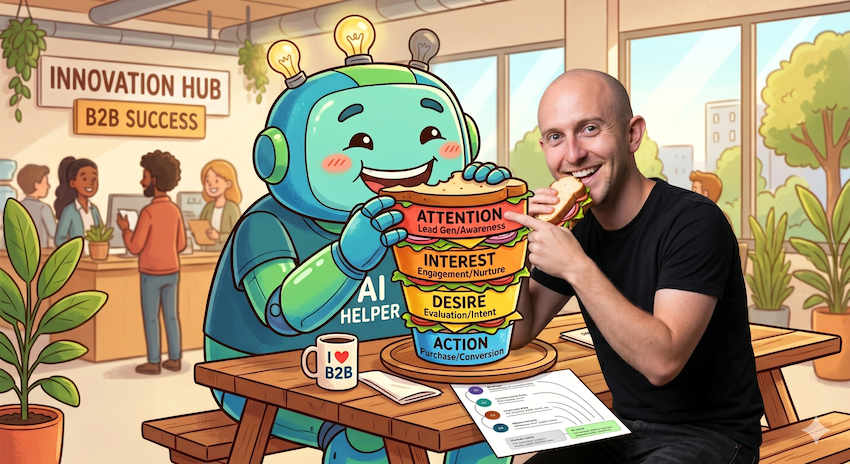
I don't think enough people realize how big of a shift is happening in marketing because of AI.
But it's not for the reasons you might think.
I'm not here to write about vibe coding, or how every marketer today needs to be comfortable with Claude Code, or how marketing is becoming more like engineering.
The shift is because of how buyers behave now.
Think about it:
There's no need to read someone's blog anymore. There's no need to download a PDF to get some information. No need to talk to sales to get "qualified."
Buyers can do all of that through AI now. They can research, compare, and pre-qualify you without ever filling out a form or letting you know they exist.
(Note: I am not saying don't have a blog, just using this to make a point. The company does not control the flow of information anymore).
Just think about how you are using the internet right now. It's doing a Google search and then chatting with the Google AI right there in search without ever hitting the company's website.
And yet so many marketing teams today still have this engine built around MQLs, gated content, and lead nurture sequences. But won't AI eat all of that?
The average B2B deal cycle is now 211 days. 80%+ of the buying journey is done without your company ever being in the room. By the time someone shows up on a demo form, they've often already made the decision to buy. I'm not giving you an hour of my day so you can demo your software for me after making sure I'm "qualified."
So what works today is what the kids are calling zero click marketing. You do great marketing, you put it out into the world, and you HOPE the right people come back and buy from you when they're ready. No gate, no form, no nurture track. You can't measure "credit" based on whether someone clicks a link that has the proper UTM parameters.
These are internal company issues. We need to measure marketing. We need to control the funnel so we can get credit and have proof that marketing is "working."
But can't you see how that is backwards not with AI? You can't fight it forever.
The buyer wants information as quickly and easily as possible, while the company wants to track, gate, measure, and assign credit to everything. Those two things are in direct conflict.
And the customer always wins that fight.
Some B2B brands are already operating this way. Three I've covered recently on the pod:
Ramp publishes proprietary spend data from millions of transactions and turns it into reports that get passed around every quarter. No gate. They built a category-defining content franchise out of data they were already sitting on. They use these assets to grow word of mouth, interest, and brand awareness for the problem they solve.
Rippling runs scrappy iPhone-shot brand content on social with no CTA (GASP), no form, no nothing. Ryan Narod told me on the podcast that people who see Rippling's top-of-funnel brand content convert through their bottom-of-funnel ads at twice the rate. Sales reps get on calls and hear "I promise this isn't for the AirPods, I've been seeing Rippling everywhere."
ClickUp has built one of the best B2B social brands in the world by hiring real actors, shooting 12-15 videos a week, and giving them away for free on Instagram and TikTok. Chris Cunningham told me the pipeline showed up months later, not weeks.
None of those examples would survive a traditional "what's the CAC payback on this content" review. And yet they're some of the best marketing in B2B right now.
Which brings me to the part I want you to actually sit with this week:
Your job as a marketer in 2026 might be less about running campaigns and more about educating your company on how buying actually works now, and then re-building marketing around that motion.
That's a harder job than continuing to do things the way you've always done them. It means walking into a room with your CEO and CFO and making the case for longer time horizons, looser attribution, and metrics that don't tie cleanly to a sourced pipeline number.
If you over-optimize for only the things you can specifically measure and tie directly to pipeline, you're going to miss the entire shift. Because that's not how buying works anymore. And it's getting less and less true every quarter.
Skate to where the puck is going as they say (sportsball analogy if you like). Give up some short-term measurement to play for long-term gain. Match your marketing to buyer behavior, not to what's easiest to put in a dashboard for the CFO.
This is the conversation. The marketers who can lead their companies through it are the ones who'll be running marketing in five years.
– Dave
P.S. How are you thinking about this inside your company right now? Please reply back and let me know. I'd also love more examples of how you're adapting to this shift.
Sidenote: I'd love to see Claude teach a bunch of 1st and 2nd graders the concept of an out, a foul ball, a strike, first base, three outs… so no, I'm not being replaced by anyone any time soon!!


The Exit Five newsletter

Sponsor the exitfive newsletter