
Short term vs. long term marketing (Dave's Newsletter)
.svg)

WHAT WE'RE HEARING
Can you really do short term and long term marketing at the same time?
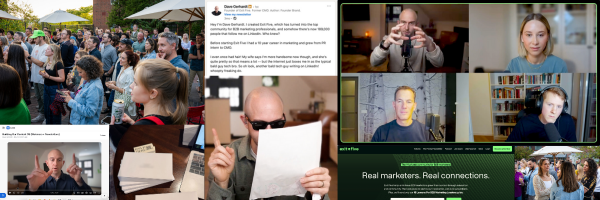
Editor's Note: Hey, me again. Happy New Year. I don’t know about you but I'm already stressing myself out about 2026. Last year was incredible. It’s gonna be hard to top. When you work hard for something, achieve the goal, you immediately start worrying about how to do it again. But I had a talk with myself and realized this: pressure is a privilege. Pressure means there's stakes now. People care. They expect you to do it again. That means something is working. It’s the dream. But here's the thing: you can't just ride what's working today. You need to build what will work tomorrow. That means investing in short-term and long-term at the same time. That’s exactly what we’re covering in today’s newsletter.
How do you invest in both short term and long term marketing?
This question comes up all the time. Because I think it's often framed that these two things have to be at odds…
But it’s possible to drive short-term results without sacrificing quality or trust.
A big part of "long term" is your brand, your reputation. That takes time.
But all of those "long term" things also can help in the short term, today too.
I know often times when people ask this question they want this answer:
Well, Rick - you should spend approximately 68% of your time and budget now on "short term" activities, and 32% of your time on "long term" "brand building" activities.
But business is not that simple. There's a lot of nuance.
I'd say do both.
I workout, I eat healthy. But I also crush ice cream and dessert and have weekends where I go completely off the rails. IT IS BOTH. You can do both things. Here’s how…
PRESENTED BY WEBFLOW
Level Up Your AEO With This Playbook

It’s the hottest topic in marketing right now. Everyone from new marketing managers to seasoned CMOs around the Exit Five universe are asking questions about AI and SEO, aka AEO.
Your buyers are learning about your brand from ChatGPT and Google before they ever hit your site. No demo. No sales call. No chance to explain yourself. That’s AEO. And it decides whether AI ignores you, mentions you, or actually recommends you. This is the future of B2B buying.
Need guidance here? You’re not alone.
This AEO Playbook is a resource you should bookmark right now. What you will learn:
- How AI tools actually form opinions about your brand
- Where traditional SEO still works and where it completely breaks
- How to tell if you’re invisible, mentioned, or trusted by AI
- What to focus on in the next 90 days without chasing hype
- A clear AEO maturity model so you know what “good” even looks like
Get smarter about AEO this week with this free resource. Click here to grab this AEO playbook now.
It All Starts With Alignment
I've found that so many challenges and issues in marketing success are rooted in the goal and how it relates back to the company goals.
You can have the perfect channel mix, but if you and your CEO disagree on the approach? You're cooked.
The key is getting alignment on what you're optimizing for and why.
Show the team which initiatives drive results now and which ones set you up for the future. Make it clear how both fit together.
You don't need a perfect percentage split, you need agreement that you're doing both.
Without that alignment, nothing else works. And it's the marketing leader’s job to drive that.
Short Term Wins Are The Secret To Getting What You Want
You want to hire a full-time events person. You think podcasting could work. You want to invest in community.
Don't just ask for budget and hope for a “Yes.”
Test first. Prove the channel. Then make the business case.
- Example: You want to hire a full-time events person. Run 1–2 small events with your current team first. Get some data. Figure out what the role needs to do. Then go to your CEO with proof. Here's what we did. Here's what we got. Here's what it cost. Here's what we'll get if we go full-time on this.
The CEO doesn't want to hear "trust me, events will work." They want to see that you've already proven it on a small scale.
You can't set the right goals for something you've never done before. If you've never run a mile, you can't set the right pace for a marathon.
Start with experiments. Set guardrails. Focus on action over perfect goal-setting in the early days.
The more wins you have, the more trust you’ll get.
Short Term Tactics: Doing The Hard Things That Don’t Scale
It’s all relative. If you need 10 customers NOW or else you'll go out of business, then you better get knocking. You can’t be worrying about the fun brand stuff.
But short term doesn't mean bad marketing. It means doing things that help you sell more today while setting you up for success longer term.
Here's what that might look like:
- 1-to-1 conversations. Not scalable, but high-converting. DMing prospects. Showing up in Slack communities. Answering questions in forums where your buyers hang out.
- Webinars with a clear CTA. Educational content that drives demo requests or trial sign-ups the same week.
- Running ads to bottom-of-funnel searches. Someone Googles "best CRM for sales teams" and you're there. You're not creating demand, you're capturing it when they're ready to buy.
- Personalized video demos for warm leads. Record a 2-minute Loom walking through exactly how you'd solve their specific problem. Takes 10 minutes. Converts like crazy.
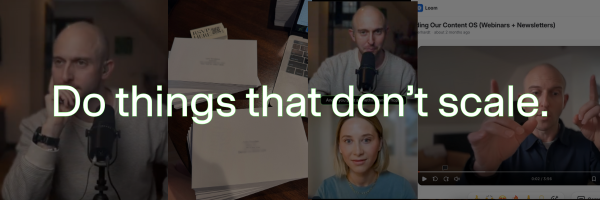
- Handwritten direct mail. For your next event, send handwritten invites to your top prospects. That’s what we did at Exit Five for our Marketing Leadership Retreat in March. Personalized invites to a hand-picked list of 100 execs. Then a follow-up email showing the invite going into the mailbox.
%2520(1).png)
The thread running through all of these: they drive pipeline now. But they also reinforce your brand every time someone sees you. That compounds over time.
Playing The Long Game
The easiest way to hit your number is to invest in what’s working now, a year ago. But since you can’t go back in time…
The best channels take time to pay off. The good news? Once they start working, they keep working.
This can look like:
- Podcasting. I've been doing this for 10 years. 500+ episodes across five different shows. And I can tell you the ROI is real. You spend an hour with your ideal customer or a key player in your industry. You build a relationship. You create audio and video content you can use for months. You build employment brand (nearly every candidate we talk to at Exit Five mentions listening to the podcast first). And yes, it drives sales long term.
- LinkedIn thought leadership. I've been posting on LinkedIn for years. I have 192,672 followers (but who’s counting?). LinkedIn is an incredible channel in B2B. Because B2B social media continues to be an underrated marketing channel. It is quite literally how humans get information and make buying decisions. Dasha Shakov (Head of Marketing at Proton.ai) said on our live session recently, “LinkedIn is the only social channel where the barrier to entry is low, the targeting is built in, and it actually feels professional to consume content during the workday. People are learning there. And they feel productive doing it.”
- Community. I've built a business around community and community building has been one of my key plays as a B2B marketer. It’s a great business strategy because you’re building relationships with future customers. It’s much easier to sell something when someone knows you, likes you, and trusts you first.
None of this shows up as "sourced by podcast" in your CRM. But talk to your best customers and ask how they found you. They'll mention the podcast they binged. The LinkedIn posts they saved. The community member who told them to check you out. That’s the dream.
A Short And Long Term System You Can Steal
A Kanban board is one simple thing that has been timeless and over 15 years still hasn’t gone out of style.
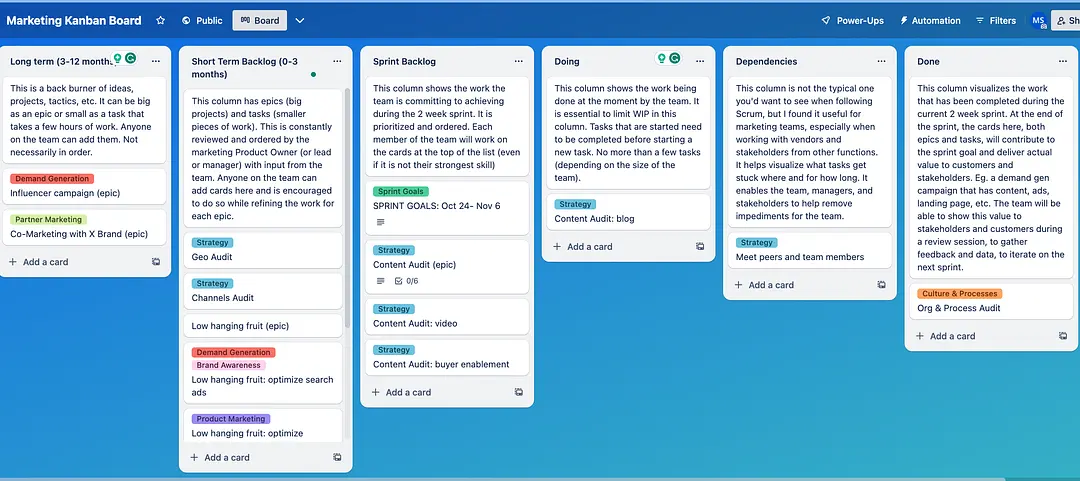
It helps you visualize what's happening across different time horizons:
- Long term (3-12 months). Big projects. Ideas. Stuff on the back burner.
- Short term backlog (0-3 months). What you're working on next.
- Sprint backlog. What your team commits to this sprint (usually 2 weeks).
- Doing. Work in progress. Limit this column so you finish things instead of starting everything.
- Dependencies. Where you're waiting on vendors or other teams.
- Done. What shipped this sprint.
The board shows progress. It keeps you focused. It makes it obvious when something's stuck.
And it helps you explain to the rest of the company what marketing is working on and why.
Because let’s be real. Balancing short and long term activities usually comes down to measurement. It’s hard to justify the longer term plays when you’re comparing against something that will pay off right away (like ads). But making it clear what you’re prioritizing paints a much fuller picture for anyone who’s not in it day to day.
This is just one simple example. I’ve been working in marketing 15 years now and the tools keep changing (back when I first started I remember this guy had a Kanban board with post-it notes on a big whiteboard). But the tool isn’t as important as the system. I’ve always loved the idea of having an icebox, parking lot, or backlog of future projects.
But tell me - How do you manage this? How do you track long term and short term activities?
Speak Your Goals Into Existence (It Works, I Swear)
I've seen it every year with our business. We make up goals and plans. And every year we hit them.
Goals work as magnets. They pull you toward the outcome.
I also believe you need guardrails. Deadlines. Plans. They're forcing functions for getting things done.
So yes, do both.
Set the long-term vision. Build the systems that will compound over time.
And hit your short-term number. Prove the channel. Make the sale.
Marketing isn't just about quick wins. The best marketing teams invest in consistent execution, brand-building, and long-term relationships.
– Dave
P.S. Do things that don’t scale. Pick up the phone. Write a handwritten note. Go see customers. Please!!! This is where the nuance lives. You can’t just get it all from recordings of calls and transcripts and recaps from your AI note taker. I’m being reminded of this first hand right now. Matt on our team has done 50 sales calls with CMOs in the last 30 days. He’s not a sales guy! He’s the community guy! Do you know how valuable that information has been??
So hit reply and tell me…what’s one thing that doesn’t scale that you want to try this year?


The Exit Five newsletter

Sponsor the exitfive newsletter